Skip to content

Publications

2026

9 papers
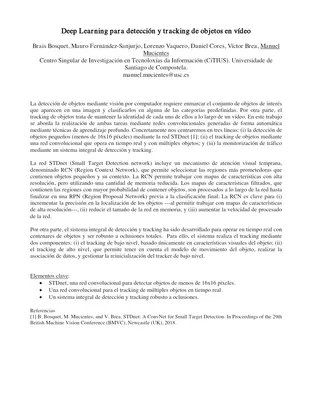
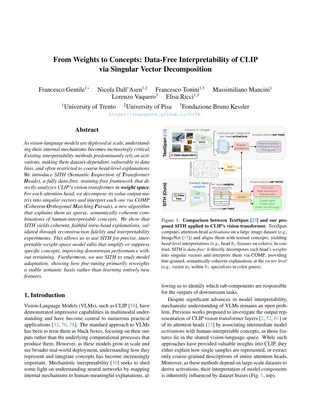
Cover of From Weights to Concepts: Data-Free Interpretability of CLIP via Singular Vector Decomposition

From Weights to Concepts: Data-Free Interpretability of CLIP via Singular Vector Decomposition

From Weights to Concepts: Data-Free Interpretability of CLIP via Singular Vector Decomposition — paper details

Francesco Gentile, Nicola Dall'Asen, Francesco Tonini, Massimiliano Mancini, Lorenzo Vaquero, Elisa Ricci

IEEE/CVF Conference on Computer Vision and Pattern Recognition

A data-free, training-free framework that directly analyses CLIP's vision transformer in weight space, decomposing each attention head into singular vectors linked to textual concepts.

As vision-language models are deployed at scale, understanding their internal mechanisms becomes increasingly critical. Existing interpretability methods predominantly rely on activations, making them dataset-dependent, vulnerable to data bias, and often restricted to coarse head-level explanations. We introduce SITH (Semantic Inspection of Transformer Heads), a fully data-free, training-free framework that directly analyses CLIP’s vision transformer in weight space. For each attention head, we decompose its value-output matrix into singular vectors and interpret each one via COMP (Coherent Orthogonal Matching Pursuit), a new algorithm that explains them as sparse, semantically coherent combinations of human-interpretable concepts. We show that SITH yields coherent, faithful intra-head explanations, validated through reconstruction fidelity and interpretability experiments. This allows us to use SITH for precise, interpretable weight-space model edits that amplify or suppress specific concepts, improving downstream performance without retraining. Furthermore, we use SITH to study model adaptation, showing how fine-tuning primarily reweights a stable semantic basis rather than learning entirely new features.

@inproceedings{gentile2026fromweights,
  author    = {Francesco Gentile and
               Nicola Dall'Asen and
               Francesco Tonini and
               Massimiliano Mancini and
               Lorenzo Vaquero and
               Elisa Ricci},
  title     = {From Weights to Concepts: Data-Free Interpretability of {CLIP} via
               Singular Vector Decomposition},
  booktitle = {{IEEE} Conf. Comput. Vis. Pattern Recog. ({CVPR})},
  pages     = {2895-2906},
  year      = {2026}
}
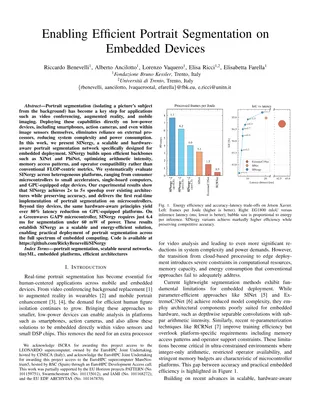
Cover of Enabling Efficient Portrait Segmentation on Embedded Devices

Enabling Efficient Portrait Segmentation on Embedded Devices

Enabling Efficient Portrait Segmentation on Embedded Devices — paper details

Riccardo Benevelli, Alberto Ancilotto, Lorenzo Vaquero, Elisa Ricci, Elisabetta Farella

IEEE International Conference on Pervasive Computing and Communications Workshops

SINergy is a scalable portrait segmentation network designed around embedded hardware constraints, reaching real-time segmentation on microcontroller-scale devices.

PDFCode

Portrait segmentation, isolating a picture’s subject from the background, has become a key step for applications such as video conferencing, augmented reality, and mobile imaging. Deploying these capabilities directly on low-power devices, including smartphones, action cameras, and even within image sensors themselves, eliminates reliance on external processors and reduces system complexity and power consumption. We present SINergy, a scalable and hardware-aware portrait segmentation network specifically designed for embedded deployment. SINergy builds upon efficient backbones such as XiNet and PhiNet, optimizing arithmetic intensity, memory access patterns, and operator compatibility rather than conventional FLOP-centric metrics. We systematically evaluate SINergy across heterogeneous platforms, ranging from consumer microcontrollers to small accelerators, single-board computers, and GPU-equipped edge devices. Experimental results show that SINergy achieves 2x to 5x speedup over existing architectures while preserving accuracy, and delivers the first real-time implementation of portrait segmentation on microcontrollers.

@inproceedings{benevelli2026enabling,
  author    = {Riccardo Benevelli and
               Alberto Ancilotto and
               Lorenzo Vaquero and
               Elisa Ricci and
               Elisabetta Farella},
  title     = {Enabling Efficient Portrait Segmentation on Embedded Devices},
  booktitle = {{IEEE} Int. Conf. Pervasive Comput. Commun. Workshops
               ({PerCom Workshops})},
  year      = {2026},
  doi     = {10.1109/PerComWorkshops68308.2026.11585435}
}
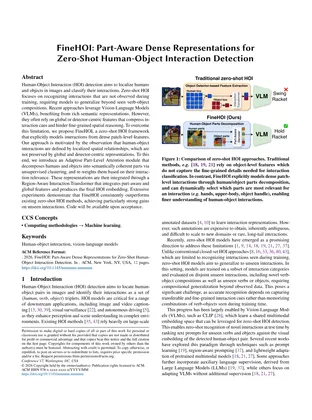
Cover of FineHOI: Part-Aware Dense Representations for Zero-Shot Human-Object Interaction Detection

FineHOI: Part-Aware Dense Representations for Zero-Shot Human-Object Interaction Detection

FineHOI: Part-Aware Dense Representations for Zero-Shot Human-Object Interaction Detection — paper details

Francesco Tonini, Lorenzo Vaquero, Mohammad Mahdi Derakhshani, Cees G. M. Snoek, Elisa Ricci, Cigdem Beyan

ACM International Conference on Multimedia

FineHOI detects unseen human-object interactions by reasoning over dense, part-level visual cues, improving fine-grained recognition without LLM or detector features.

Human-Object Interaction (HOI) detection aims to localize humans and objects in images and classify their interactions. Zero-shot HOI focuses on recognizing interactions that are not observed during training, requiring models to generalize beyond seen verb-object compositions. Recent approaches leverage Vision-Language Models (VLMs), benefiting from rich semantic representations. However, they often rely on global or detector-centric features that compress interaction cues and hinder fine-grained spatial reasoning. To overcome this limitation, we propose FineHOI, a zero-shot HOI framework that explicitly models interactions from dense patch-level features. Our approach is motivated by the observation that human-object interactions are defined by localized spatial relationships, which are not preserved by global and detector-centric representations. To this end, we introduce an Adaptive Part-Level Attention module that decomposes humans and objects into semantically coherent parts via unsupervised clustering, and re-weights them based on their interaction relevance. These representations are then integrated through a Region-Aware Interaction Transformer that integrates part-aware and global features and produces the final HOI embedding. Extensive experiments demonstrate that FineHOI consistently outperforms existing zero-shot HOI methods, achieving particularly strong gains on unseen interactions. Code will be available upon acceptance.

@inproceedings{tonini2026finehoi,
  author    = {Francesco Tonini and
               Lorenzo Vaquero and
               Mohammad Mahdi Derakhshani and
               Cees G. M. Snoek and
               Elisa Ricci and
               Cigdem Beyan},
  title     = {FineHOI: Part-Aware Dense Representations for Zero-Shot Human-Object Interaction Detection},
  booktitle = {Proc. {ACM} Int. Conf. Multimedia ({ACM MM})},
  year      = {2026},
}
Cover of Humanity's Last Exam: A Benchmark of Expert-Level Academic Questions to Assess AI Capabilities

Humanity's Last Exam: A Benchmark of Expert-Level Academic Questions to Assess AI Capabilities

Humanity's Last Exam: A Benchmark of Expert-Level Academic Questions to Assess AI Capabilities — paper details

Center for AI Safety, Scale AI, HLE Contributors Consortium

Nature

Humanity's Last Exam is a multimodal benchmark of 2,500 expert-level closed-ended academic questions designed to measure frontier AI capabilities beyond saturated benchmarks.

PDFCodeWebsite

Benchmarks are important tools for tracking the rapid advancements in large language model capabilities. However, benchmarks are not keeping pace in difficulty: LLMs now achieve more than 90% accuracy on popular benchmarks such as MMLU, limiting informed measurement of state-of-the-art LLM capabilities. In response, Humanity’s Last Exam (HLE) introduces a multimodal benchmark at the frontier of human knowledge, designed as an expert-level closed-ended academic benchmark with broad subject coverage. HLE consists of 2,500 questions across dozens of subjects, including mathematics, humanities, and the natural sciences. It was developed globally by subject-matter experts and contains multiple-choice and short-answer questions suitable for automated grading. Each question has a known solution that is unambiguous and easily verifiable but cannot be quickly answered by internet retrieval. State-of-the-art LLMs demonstrate low accuracy and calibration on HLE, highlighting a marked gap between current model capabilities and the expert human frontier on closed-ended academic questions.

@article{centerforaisafety2026benchmark,
  author  = {{Center for AI Safety} and
             {Scale AI} and
             {HLE Contributors Consortium}},
  title   = {A Benchmark of Expert-Level Academic Questions to Assess {AI}
             Capabilities},
  journal = {Nature},
  volume  = {649},
  number  = {8099},
  pages   = {1139-1146},
  year    = {2026},
  doi     = {10.1038/s41586-025-09962-4}
}
Cover of Keynote on Overcoming Detector Failures in Online Multi-Object Tracking

Keynote on Overcoming Detector Failures in Online Multi-Object Tracking

Keynote on Overcoming Detector Failures in Online Multi-Object Tracking — paper details

Lorenzo Vaquero, Yihong Xu, Xavier Alameda-Pineda, Víctor M. Brea, Manuel Mucientes

Conference of the Spanish Association for Artificial Intelligence

This keynote paper summarizes BUSCA, a work published in ECCV'24. BUSCA plugs into online tracking-by-detection systems to recover objects missed by detectors through proposal generation and decision-transformer association.

PDFPosterCodeVideo

This keynote paper summarizes BUSCA, a work published in the European Conference on Computer Vision 2024. Multi-object tracking (MOT) endeavors to precisely estimate the positions and identities of multiple objects over time. The prevailing approach, tracking-by-detection (TbD), first detects objects and then links detections, resulting in a simple yet effective method. However, contemporary detectors may occasionally miss some objects in certain frames, causing trackers to cease tracking prematurely. To tackle this issue, we propose BUSCA, a versatile framework compatible with any online TbD system, enhancing its ability to persistently track those objects missed by the detector, primarily due to occlusions. Remarkably, this is accomplished without modifying past tracking results or accessing future frames, i.e., in a fully online manner. BUSCA generates proposals based on neighboring tracks, motion, and learned tokens. Utilizing a decision Transformer that integrates multimodal visual and spatiotemporal information, it addresses the object-proposal association as a multi-choice question-answering task. BUSCA is trained independently of the underlying tracker, solely on synthetic data, without requiring fine-tuning. Through BUSCA, we showcase consistent performance enhancements across five different trackers and establish a new state-of-the-art baseline across three different benchmarks. Code available at: https://github.com/lorenzovaquero/BUSCA.

@inproceedings{vaquero2026keynotelost,
  author    = {Lorenzo Vaquero and
               Yihong Xu and
               Xavier Alameda-Pineda and
               V{\'{\i}}ctor M. Brea and
               Manuel Mucientes},
  title     = {Keynote on Overcoming Detector Failures in Online
               Multi-object Tracking},
  booktitle = {Conference of the Spanish Association for Artificial Intelligence ({CAEPIA})},
  year      = {2026},
}
Cover of Keynote on Superpowering Open-Vocabulary Object Detectors for X-ray Vision

Keynote on Superpowering Open-Vocabulary Object Detectors for X-ray Vision

Keynote on Superpowering Open-Vocabulary Object Detectors for X-ray Vision — paper details

Pablo Garcia-Fernandez, Lorenzo Vaquero, Mingxuan Liu, Feng Xue, Daniel Cores, Nicu Sebe, Manuel Mucientes, Elisa Ricci

Conference of the Spanish Association for Artificial Intelligence

This keynote paper summarizes RAXO, a work published in ICCV'25. RAXO adapts RGB open-vocabulary detectors to X-ray imagery with training-free visual descriptors and introduces DET-COMPASS for large-scale X-ray OvOD evaluation.

This keynote paper summarizes RAXO, a work published in the IEEE/CVF International Conference on Computer Vision 2025. Open-vocabulary object detection (OvOD) is set to revolutionize security screening by enabling systems to recognize any item in X-ray scans. However, developing effective OvOD models for X-ray imaging presents unique challenges due to data scarcity and the modality gap that prevents direct adoption of RGB-based solutions. To overcome these limitations, we propose RAXO, a training-free framework that repurposes off-the-shelf RGB OvOD detectors for robust X-ray detection. RAXO builds high-quality X-ray class descriptors using a dual-source retrieval strategy. It gathers relevant RGB images from the web and enriches them via a novel X-ray material transfer mechanism, eliminating the need for labeled databases. These visual descriptors replace text-based classification in OvOD, leveraging intra-modal feature distances for robust detection. Extensive experiments demonstrate that RAXO consistently improves OvOD performance, providing an average mAP increase of up to 17.0 points over base detectors. To further support research in this emerging field, we also introduce DET-COMPASS, a new benchmark featuring bounding box annotations for over 300 object categories, enabling large-scale evaluation of OvOD in X-ray.

@inproceedings{garciafernandez2026keynotesuperpowering,
  author    = {Pablo Garcia-Fernandez and
               Lorenzo Vaquero and
               Mingxuan Liu and
               Feng Xue and
               Daniel Cores and
               Nicu Sebe and
               Manuel Mucientes and
               Elisa Ricci},
  title     = {Keynote on Superpowering Open-Vocabulary Object Detectors for X-ray
               Vision},
  booktitle = {Conference of the Spanish Association for Artificial Intelligence ({CAEPIA})},
  year      = {2026}
}
Cover of Towards Unconstrained Human-Object Interaction

Towards Unconstrained Human-Object Interaction

Towards Unconstrained Human-Object Interaction — paper details

Francesco Tonini, Alessandro Conti, Lorenzo Vaquero, Cigdem Beyan, Elisa Ricci

IEEE International Conference on Automatic Face and Gesture Recognition

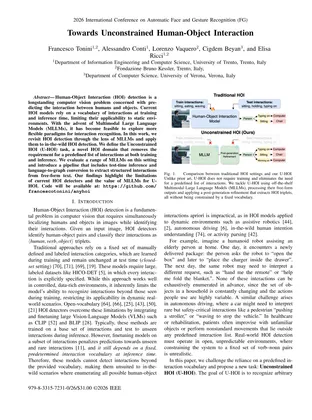
AnyHOI studies human-object interaction detection without a predefined interaction vocabulary, using multimodal LLMs and language-to-graph conversion to recover structured triplets from free-form outputs.

PDFPosterCode

Human-Object Interaction (HOI) detection is a longstanding computer vision problem concerned with predicting the interaction between humans and objects. Current HOI models rely on a vocabulary of interactions at training and inference time, limiting their applicability to static environments. With the advent of Multimodal Large Language Models (MLLMs), it has become feasible to explore more flexible paradigms for interaction recognition. In this work, we revisit HOI detection through the lens of MLLMs and apply them to in-the-wild HOI detection. We define the Unconstrained HOI (U-HOI) task, a novel HOI domain that removes the requirement for a predefined list of interactions at both training and inference. We evaluate a range of MLLMs on this setting and introduce a pipeline that includes test-time inference and language-to-graph conversion to extract structured interactions from free-form text. Our findings highlight the limitations of current HOI detectors and the value of MLLMs for U-HOI.

@inproceedings{tonini2026towards,
  author    = {Francesco Tonini and
               Alessandro Conti and
               Lorenzo Vaquero and
               Cigdem Beyan and
               Elisa Ricci},
  title     = {Towards Unconstrained Human-Object Interaction},
  booktitle = {{IEEE} Int. Conf. Autom. Face Gesture Recognit. ({FG})},
  year      = {2026}
}
Cover of Training-Free Semantic Multi-Object Tracking with Vision-Language Models

Training-Free Semantic Multi-Object Tracking with Vision-Language Models

Training-Free Semantic Multi-Object Tracking with Vision-Language Models — paper details

Laurence Bonat, Francesco Tonini, Elisa Ricci, Lorenzo Vaquero

IEEE International Conference on Automatic Face and Gesture Recognition

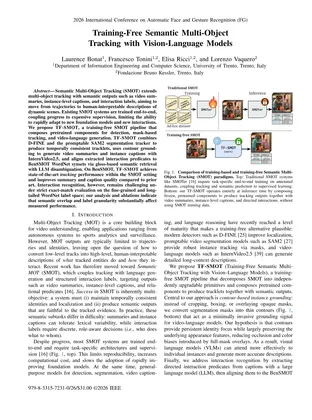
TF-SMOT composes frozen detection, segmentation tracking, video-language generation, and LLM disambiguation modules to produce semantic tracking outputs without task-specific training.

PDF

Semantic Multi-Object Tracking (SMOT) extends multi-object tracking with semantic outputs such as video summaries, instance-level captions, and interaction labels, aiming to move from trajectories to human-interpretable descriptions of dynamic scenes. Existing SMOT systems are trained end-to-end, coupling progress to expensive supervision and limiting the ability to rapidly adapt to new foundation models and interactions. We propose TF-SMOT, a training-free SMOT pipeline that composes pretrained components for detection, mask-based tracking, and video-language generation. TF-SMOT combines D-FINE and the promptable SAM2 segmentation tracker to produce temporally consistent tracklets, uses contour grounding to generate video summaries and instance captions with InternVideo2.5, and aligns extracted interaction predicates to BenSMOT WordNet synsets via gloss-based semantic retrieval with LLM disambiguation. On BenSMOT, TF-SMOT achieves state-of-the-art tracking performance within the SMOT setting and improves summary and caption quality compared to prior art. Interaction recognition remains challenging under strict exact-match evaluation on the fine-grained and long-tailed WordNet label space; our analysis and ablations indicate that semantic overlap and label granularity substantially affect measured performance.

@inproceedings{bonat2026trainingfree,
  author    = {Laurence Bonat and
               Francesco Tonini and
               Elisa Ricci and
               Lorenzo Vaquero},
  title     = {Training-Free Semantic Multi-Object Tracking with
               Vision-Language Models},
  booktitle = {{IEEE} Int. Conf. Autom. Face Gesture Recognit. ({FG})},
  year      = {2026}
}
  • Oral
Cover of Zero-Shot Temporal Action Localization Through Textual Guidance

Zero-Shot Temporal Action Localization Through Textual Guidance

Zero-Shot Temporal Action Localization Through Textual Guidance — paper details

Benedetta Liberatori, Alessandro Conti, Lorenzo Vaquero, Paolo Rota, Yiming Wang, Elisa Ricci

IEEE International Conference on Automatic Face and Gesture Recognition

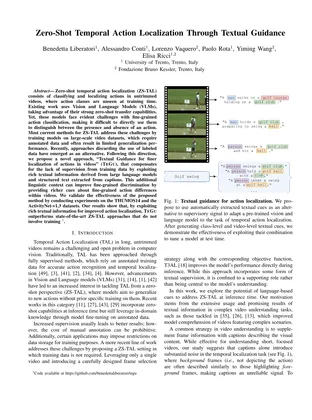
TeGu compensates for the lack of supervision in zero-shot temporal action localization by exploiting rich textual cues from large language models, distinguishing foreground from background frames without training.

PDFCode

Zero-shot temporal action localization (ZS-TAL) consists of classifying and localizing actions in untrimmed videos, where action classes are unseen at training time. Existing work uses Vision and Language Models (VLMs), taking advantage of their strong zero-shot transfer capabilities. Yet, these models face evident challenges with fine-grained action classification, making it difficult to directly use them to distinguish between the presence and absence of an action. Most current methods for ZS-TAL address these challenges by training models on large-scale video datasets, which require annotated data and often result in limited generalization performance. Recently, approaches discarding the use of labeled data have emerged as an alternative. Following this direction, we propose a novel approach, TeGu (Textual Guidance for finer localization of actions in videos), that compensates for the lack of supervision from training data by exploiting rich textual information derived from large language models and structured text extracted from captions. This additional linguistic context can improve fine-grained discrimination by providing richer cues about fine-grained action differences within videos. We validate the effectiveness of the proposed method by conducting experiments on the THUMOS14 and the ActivityNet-v1.3 datasets. Our results show that, by exploiting rich textual information for improved action localization, TeGu outperforms state-of-the-art ZS-TAL approaches that do not involve training.

@inproceedings{liberatori2026zeroshot,
  author    = {Benedetta Liberatori and
               Alessandro Conti and
               Lorenzo Vaquero and
               Paolo Rota and
               Yiming Wang and
               Elisa Ricci},
  title     = {Zero-Shot Temporal Action Localization Through Textual
               Guidance},
  booktitle = {{IEEE} Int. Conf. Autom. Face Gesture Recognit. ({FG})},
  year      = {2026}
}
2025

4 papers
Cover of ConViS-Bench: Estimating Video Similarity Through Semantic Concepts

ConViS-Bench: Estimating Video Similarity Through Semantic Concepts

ConViS-Bench: Estimating Video Similarity Through Semantic Concepts — paper details

Benedetta Liberatori, Alessandro Conti, Lorenzo Vaquero, Yiming Wang, Elisa Ricci, Paolo Rota

Conference on Neural Information Processing Systems Datasets and Benchmarks Track

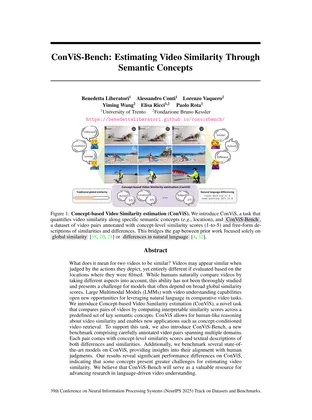
ConViS-Bench evaluates video similarity along semantic concepts, pairing concept-level human scores with free-form descriptions for interpretable video comparison.

What does it mean for two videos to be similar? Videos may appear similar when judged by the actions they depict, yet entirely different if evaluated based on the locations where they were filmed. While humans naturally compare videos by taking different aspects into account, this ability has not been thoroughly studied and presents a challenge for models that often depend on broad global similarity scores. We introduce Concept-based Video Similarity estimation (ConViS), a task that compares pairs of videos by computing interpretable similarity scores across a predefined set of key semantic concepts. To support this task, we introduce ConViS-Bench, a benchmark comprising carefully annotated video pairs spanning multiple domains. Each pair comes with concept-level similarity scores and textual descriptions of both differences and similarities. We benchmark several state-of-the-art models on ConViS, providing insights into their alignment with human judgments and highlighting concept-specific challenges in video similarity estimation.

@inproceedings{liberatori2025convisbench,
  author    = {Benedetta Liberatori and
               Alessandro Conti and
               Lorenzo Vaquero and
               Yiming Wang and
               Elisa Ricci and
               Paolo Rota},
  title     = {{ConViS-Bench}: Estimating Video Similarity Through Semantic
               Concepts},
  booktitle = {The Thirty-Ninth Annual Conference on Neural Information
               Processing Systems Datasets and Benchmarks Track},
  volume = {38},
  year      = {2025}
}
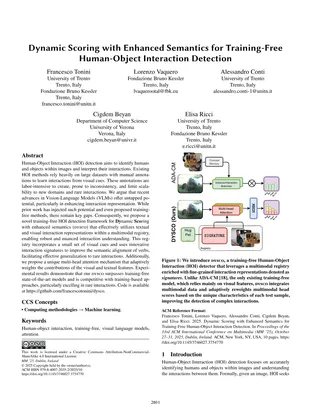
Cover of Dynamic Scoring with Enhanced Semantics for Training-Free Human-Object Interaction Detection

Dynamic Scoring with Enhanced Semantics for Training-Free Human-Object Interaction Detection

Dynamic Scoring with Enhanced Semantics for Training-Free Human-Object Interaction Detection — paper details

Francesco Tonini, Lorenzo Vaquero, Alessandro Conti, Cigdem Beyan, Elisa Ricci

ACM International Conference on Multimedia

DYSCO is a training-free HOI detector that combines textual and visual interaction representations in a multimodal registry with dynamic multi-head scoring.

PDFCode

Human-Object Interaction (HOI) detection aims to identify humans and objects within images and interpret their interactions. Existing HOI methods rely heavily on large datasets with manual annotations to learn interactions from visual cues, but these annotations are labor-intensive, inconsistent, and difficult to scale to new domains and rare interactions. We propose Dynamic Scoring with enhanced semantics (DYSCO), a training-free HOI detection framework that uses textual and visual interaction representations within a multimodal registry for robust interaction understanding. The registry incorporates a small set of visual cues and interaction signatures to improve semantic alignment of verbs, and a multi-head attention mechanism adaptively weights visual and textual features for each test sample. DYSCO surpasses training-free state-of-the-art models and is competitive with training-based approaches, particularly on rare interactions.

@inproceedings{tonini2025dynamic,
  author    = {Francesco Tonini and
               Lorenzo Vaquero and
               Alessandro Conti and
               Cigdem Beyan and
               Elisa Ricci},
  title     = {Dynamic Scoring with Enhanced Semantics for Training-Free
               Human-Object Interaction Detection},
  booktitle = {Proc. {ACM} Int. Conf. Multimedia ({ACM MM})},
  pages     = {2801-2810},
  year      = {2025},
  doi       = {10.1145/3746027.3754770}
}
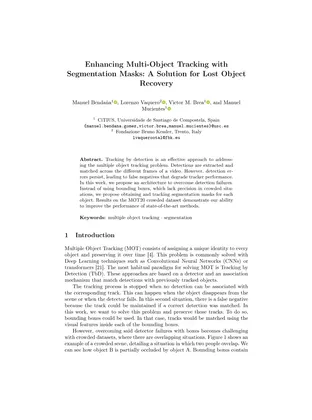
Cover of Enhancing Multi-Object Tracking with Segmentation Masks: A Solution for Lost Object Recovery

Enhancing Multi-Object Tracking with Segmentation Masks: A Solution for Lost Object Recovery

Enhancing Multi-Object Tracking with Segmentation Masks: A Solution for Lost Object Recovery — paper details

Manuel Bendaña, Lorenzo Vaquero, Víctor M. Brea, Manuel Mucientes

Iberian Conference on Pattern Recognition and Image Analysis

A lost-track recovery architecture uses segmentation masks and a transformer-based mask selector to preserve tracks when detectors fail in crowded scenes.

PDF

Tracking by detection is an effective approach to multiple object tracking: detections are extracted and matched across video frames. However, detection errors persist, leading to false negatives that degrade tracker performance. We propose an architecture to overcome detection failures by obtaining and tracking segmentation masks for each object instead of relying only on bounding boxes, which can lack precision in crowded scenes. When a detector fails and a track cannot be associated, the track is sent to a Lost Tracks Recovery (LTR) architecture. LTR combines an off-the-shelf mask generation network, a transformer-based mask selection network, and a segmentation-based tracker to preserve identities through missed detections. Results on the MOT20 crowded dataset show improved performance for state-of-the-art tracking systems.

@inproceedings{bendana2025enhancing,
  author    = {Manuel Benda{\~n}a and
               Lorenzo Vaquero and
               V{\'{\i}}ctor M. Brea and
               Manuel Mucientes},
  title     = {Enhancing Multi-Object Tracking with Segmentation Masks:
               A Solution for Lost Object Recovery},
  booktitle = {Pattern Recognition and Image Analysis},
  series    = {Lecture Notes in Computer Science},
  pages     = {68-79},
  year      = {2025},
  doi       = {10.1007/978-3-031-99565-1_6}
}
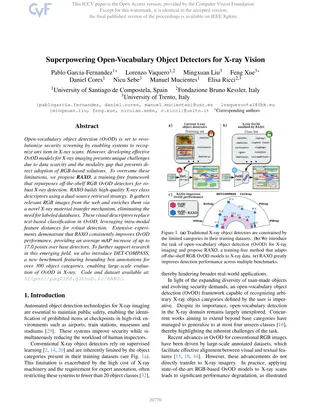
Cover of Superpowering Open-Vocabulary Object Detectors for X-ray Vision

Superpowering Open-Vocabulary Object Detectors for X-ray Vision

Superpowering Open-Vocabulary Object Detectors for X-ray Vision — paper details

Pablo Garcia-Fernandez, Lorenzo Vaquero, Mingxuan Liu, Feng Xue, Daniel Cores, Nicu Sebe, Manuel Mucientes, Elisa Ricci

IEEE/CVF International Conference on Computer Vision

RAXO adapts RGB open-vocabulary detectors to X-ray imagery with training-free visual descriptors and introduces DET-COMPASS for large-scale X-ray OvOD evaluation.

Open-vocabulary object detection is set to revolutionize security screening by enabling systems to recognize any item in X-ray scans. However, developing effective open-vocabulary object detectors for X-ray imaging presents unique challenges due to data scarcity and the modality gap that prevents direct adoption of RGB-based solutions. We propose RAXO, a training-free framework that repurposes off-the-shelf RGB open-vocabulary detectors for robust X-ray detection. RAXO builds high-quality X-ray class descriptors using a dual-source retrieval strategy, gathering relevant RGB images from the web and enriching them through an X-ray material transfer mechanism. These visual descriptors replace text-based classification, leveraging intra-modal feature distances for robust detection. Experiments show consistent improvements over base detectors, and the work introduces DET-COMPASS, a benchmark with bounding box annotations for over 300 object categories.

@inproceedings{garciafernandez2025superpowering,
  author    = {Pablo Garcia-Fernandez and
               Lorenzo Vaquero and
               Mingxuan Liu and
               Feng Xue and
               Daniel Cores and
               Nicu Sebe and
               Manuel Mucientes and
               Elisa Ricci},
  title     = {Superpowering Open-Vocabulary Object Detectors for X-ray
               Vision},
  booktitle = {{IEEE/CVF} Int. Conf. Comput. Vis. ({ICCV})},
  pages     = {20770--20779},
  year      = {2025}
}

2024

3 papers
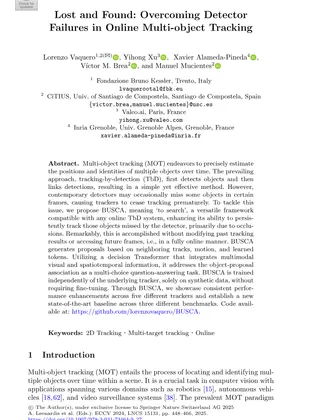
Cover of Lost and Found: Overcoming Detector Failures in Online Multi-Object Tracking

Lost and Found: Overcoming Detector Failures in Online Multi-Object Tracking

Lost and Found: Overcoming Detector Failures in Online Multi-Object Tracking — paper details

Lorenzo Vaquero, Yihong Xu, Xavier Alameda-Pineda, Víctor M. Brea, Manuel Mucientes

European Conference on Computer Vision

BUSCA plugs into online tracking-by-detection systems to recover objects missed by detectors through proposal generation and decision-transformer association.

PDFPosterCodeVideo

Multi-object tracking (MOT) estimates the positions and identities of multiple objects over time. Tracking-by-detection first detects objects and then links detections, resulting in a simple and effective paradigm, but contemporary detectors may miss objects in some frames and cause trackers to stop tracking prematurely. We propose BUSCA, a framework compatible with any online tracking-by-detection system that persistently tracks objects missed by the detector, primarily due to occlusions. BUSCA generates proposals based on neighboring tracks, motion, and learned tokens, then uses a decision Transformer that integrates visual and spatiotemporal information to address object-proposal association as a multi-choice question-answering task. BUSCA is trained independently of the underlying tracker, solely on synthetic data and without fine-tuning, yielding consistent improvements across multiple trackers and benchmarks.

@inproceedings{vaquero2024lost,
  author    = {Lorenzo Vaquero and
               Yihong Xu and
               Xavier Alameda-Pineda and
               V{\'{\i}}ctor M. Brea and
               Manuel Mucientes},
  title     = {Lost and Found: Overcoming Detector Failures in Online
               Multi-object Tracking},
  booktitle = {Eur. Conf. Comput. Vis. ({ECCV})},
  pages     = {448-466},
  year      = {2024},
  doi       = {10.1007/978-3-031-73464-9_27}
}
Cover of AL-GTD: Deep Active Learning for Gaze Target Detection

AL-GTD: Deep Active Learning for Gaze Target Detection

AL-GTD: Deep Active Learning for Gaze Target Detection — paper details

Francesco Tonini, Nicola Dall'Asen, Lorenzo Vaquero, Cigdem Beyan, Elisa Ricci

ACM International Conference on Multimedia

AL-GTD reduces gaze target annotation cost by combining supervised and self-supervised signals in an active learning acquisition function with pseudo-labeling.

PDFCode

Gaze target detection aims to determine the image location where a person is looking. Existing studies have made significant progress by regressing accurate gaze heatmaps, but these results largely rely on extensive labeled datasets that demand substantial human labor. AL-GTD reduces this reliance by integrating supervised and self-supervised losses within a sample acquisition function for active learning. It also uses pseudo-labeling to mitigate distribution shifts during training. AL-GTD achieves the best AUC results by using only 40-50% of the training data, while state-of-the-art gaze target detectors require the entire training set to reach the same performance. It also reaches satisfactory performance with 10-20% of the training data, showing that the acquisition function selects informative samples effectively.

@inproceedings{tonini2024algtd,
  author    = {Francesco Tonini and
               Nicola Dall'Asen and
               Lorenzo Vaquero and
               Cigdem Beyan and
               Elisa Ricci},
  title     = {{AL-GTD}: Deep Active Learning for Gaze Target Detection},
  booktitle = {Proc. {ACM} Int. Conf. Multimedia ({ACM MM})},
  pages     = {2360-2369},
  year      = {2024},
  doi       = {10.1145/3664647.3680952}
}
Cover of Live Demonstration: 5-bit signed SRAM-based DNN CIM for Image Recognition

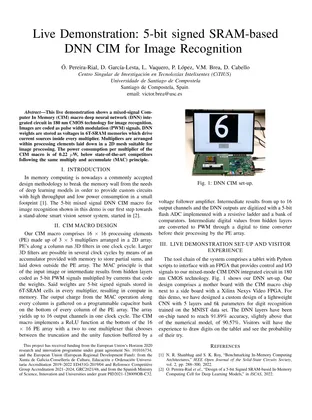
Live Demonstration: 5-bit signed SRAM-based DNN CIM for Image Recognition

Live Demonstration: 5-bit signed SRAM-based DNN CIM for Image Recognition — paper details

Ó. Pereira-Rial, D. García-Lesta, Lorenzo Vaquero, P. López, Víctor M. Brea, D. Cabello

IEEE International Symposium on Circuits and Systems

A live mixed-signal compute-in-memory demonstration uses 5-bit signed SRAM weights and PWM-coded images for low-power DNN image recognition.

PDF

This live demonstration shows a mixed-signal compute-in-memory macro deep neural network integrated circuit in 180 nm CMOS technology for image recognition. Images are coded as pulse-width modulation signals, while DNN weights are stored as voltages in 6T-SRAM memories that drive current sources inside every multiplier. Multipliers are arranged within processing elements laid down in a 2D mesh suitable for image processing. The macro implements a lightweight CNN for digit recognition on MNIST, using an FPGA and tablet interface so visitors can draw digits and see the predicted probabilities. The power consumption per multiplier of the CIM macro is 0.22 uW, below state-of-the-art competitors following the same multiply-and-accumulate principle.

@inproceedings{pereirarial2024live,
  author    = {{\'{O}}. Pereira-Rial and
               D. Garc{\'{\i}}a-Lesta and
               Lorenzo Vaquero and
               P. L{\'{o}}pez and
               V. M. Brea and
               D. Cabello},
  title     = {Live Demonstration: 5-bit signed {SRAM}-based {DNN} {CIM}
               for Image Recognition},
  booktitle = {{IEEE} Int. Symp. Circuits Syst. ({ISCAS})},
  pages     = {1-1},
  year      = {2024},
  doi       = {10.1109/ISCAS58744.2024.10558078}
}

2023

2 papers
Cover of Real-Time Siamese Multiple Object Tracker with Enhanced Proposals

Real-Time Siamese Multiple Object Tracker with Enhanced Proposals

Real-Time Siamese Multiple Object Tracker with Enhanced Proposals — paper details

Lorenzo Vaquero, Víctor M. Brea, Manuel Mucientes

Pattern Recognition

SiamMOTION tracks dozens of arbitrary objects in real time through feature-pyramid proposals, attention, inertia, pairwise depthwise RPN matching, and multi-object penalization.

PDFCode

Maintaining the identity of multiple objects in real-time video is challenging because it is not always feasible to run a detector on every frame. Motion estimation systems are often employed, but they either do not scale well with the number of targets or produce features with limited semantic information. SiamMOTION allows the tracking of dozens of arbitrary objects in real time through a proposal engine that produces quality features with attention, a region-of-interest extractor fed by an inertia module, and a feature pyramid network. Its comparison head efficiently matches exemplar and search-area pairs via a pairwise depthwise region proposal network and a multi-object penalization module. SiamMOTION is validated on five public benchmarks, achieving leading performance against state-of-the-art trackers.

@article{vaquero2023realtime,
  author  = {Lorenzo Vaquero and
             V{\'{\i}}ctor M. Brea and
             Manuel Mucientes},
  title   = {Real-Time Siamese Multiple Object Tracker with Enhanced
             Proposals},
  journal = {Pattern Recognition},
  volume  = {135},
  pages   = {109141},
  year    = {2023},
  doi     = {10.1016/j.patcog.2022.109141}
}
Cover of Depth Estimation and Image Restoration by Deep Learning from Defocused Images

Depth Estimation and Image Restoration by Deep Learning from Defocused Images

Depth Estimation and Image Restoration by Deep Learning from Defocused Images — paper details

Saqib Nazir, Lorenzo Vaquero, Manuel Mucientes, Víctor M. Brea, Daniela Coltuc

IEEE Transactions on Computational Imaging

2HDED:NET jointly estimates depth and restores all-in-focus images from defocused input through a shared encoder and parallel task branches.

PDFCode

Monocular depth estimation and image deblurring are fundamental computer vision tasks, but solving either from a single image is ill-posed. When using defocused images, depth estimation and recovery of an all-in-focus image become related through defocus physics, yet most existing models treat them separately or solve them sequentially. We propose 2HDED:NET, a two-headed depth estimation and deblurring network that solves depth estimation and image deblurring in parallel. The model extends a conventional depth-from-defocus network with a deblurring branch that shares the same encoder as the depth branch. Experiments on indoor and outdoor benchmarks, NYU-v2 and Make3D, demonstrate superior or close performance to state-of-the-art models for both depth estimation and image deblurring.

@article{nazir2023depth,
  author  = {Saqib Nazir and
             Lorenzo Vaquero and
             Manuel Mucientes and
             V{\'{\i}}ctor M. Brea and
             Daniela Coltuc},
  title   = {Depth Estimation and Image Restoration by Deep Learning from
             Defocused Images},
  journal = {{IEEE} Trans. Comput. Imaging},
  volume  = {9},
  pages   = {607-619},
  year    = {2023},
  doi     = {10.1109/TCI.2023.3288335}
}

2022

2 papers
Cover of 2HDED:NET for Joint Depth Estimation and Image Deblurring from a Single Out-of-Focus Image

2HDED:NET for Joint Depth Estimation and Image Deblurring from a Single Out-of-Focus Image

2HDED:NET for Joint Depth Estimation and Image Deblurring from a Single Out-of-Focus Image — paper details

Saqib Nazir, Lorenzo Vaquero, Manuel Mucientes, Víctor M. Brea, Daniela Coltuc

IEEE International Conference on Image Processing

2HDED:NET performs depth-from-defocus and all-in-focus image restoration in parallel through a shared encoder and two balanced decoder branches.

PDFCode

Depth estimation and all-in-focus image restoration from defocused RGB images are related problems, although most existing methods address them separately. The few approaches that solve both problems use a pipeline to derive a depth or defocus map as an intermediate product that supports image deblurring. We propose 2HDED:NET, an encoder-decoder network for depth from defocus that is extended with a deblurring branch sharing the same encoder. The two branches operate in parallel and attach equal importance to depth estimation and image restoration. The network is tested on NYU-Depth V2 and compared with state-of-the-art methods for both depth estimation and image deblurring.

@inproceedings{nazir2022twohded,
  author    = {Saqib Nazir and
               Lorenzo Vaquero and
               Manuel Mucientes and
               V{\'{\i}}ctor M. Brea and
               Daniela Coltuc},
  title     = {{2HDED}:{NET} for Joint Depth Estimation and Image Deblurring
               from a Single Out-of-Focus Image},
  booktitle = {{IEEE} Int. Conf. Image Process. ({ICIP})},
  pages     = {2006-2010},
  year      = {2022},
  doi       = {10.1109/ICIP46576.2022.9897352}
}
Cover of Fast Multi-Object Tracking with Feature Pyramid and Region Proposal Networks

Fast Multi-Object Tracking with Feature Pyramid and Region Proposal Networks

Fast Multi-Object Tracking with Feature Pyramid and Region Proposal Networks — paper details

Lorenzo Vaquero, Víctor M. Brea, Manuel Mucientes

International Conference on Pattern Recognition

SiamFAST brings feature-pyramid ROI extraction, pairwise depthwise RPN matching, and multi-object penalization to real-time arbitrary multi-object tracking.

PDFPosterCode

Many computer vision applications require real-time processing speeds, which prevents them from running an object detector on every frame. In such circumstances, motion estimation techniques are needed to maintain target identities. Instantiating multiple single-object trackers is feasible only for a few targets, while global frame-feature methods can produce features with limited semantic information and inefficient multiscale tests. SiamFAST addresses these problems with a feature-pyramid-based region-of-interest extractor for object exemplars and search areas, a pairwise depthwise region proposal network to compute similarities for several dozen objects, and a multi-object penalization module to suppress distractors. The method is validated on three public benchmarks and achieves leading performance against state-of-the-art trackers.

@inproceedings{vaquero2022fast,
  author    = {Lorenzo Vaquero and
               V{\'{\i}}ctor M. Brea and
               Manuel Mucientes},
  title     = {Fast Multi-Object Tracking with Feature Pyramid and Region
               Proposal Networks},
  booktitle = {Int. Conf. Pattern Recognit. ({ICPR})},
  pages     = {3485-3491},
  year      = {2022},
  doi       = {10.1109/ICPR56361.2022.9956673}
}

2021

1 paper
Cover of Tracking More Than 100 Arbitrary Objects at 25 FPS Through Deep Learning

Tracking More Than 100 Arbitrary Objects at 25 FPS Through Deep Learning

Tracking More Than 100 Arbitrary Objects at 25 FPS Through Deep Learning — paper details

Lorenzo Vaquero, Víctor M. Brea, Manuel Mucientes

Pattern Recognition

SiamMT scales visual object tracking to dozens of arbitrary objects by reusing feature computations and introducing efficient crop-resize and pairwise similarity operators.

PDF

Most video analytics applications rely on object detectors to localize objects in frames. When real time is required, running the detector on every frame is usually not possible, so visual object trackers are instantiated between detector calls, but this does not scale with the number of objects. SiamMT is a deep-learning multiple visual object tracking solution that applies single-object tracking principles to multiple arbitrary objects in real time. It reuses feature computations, implements a crop-and-resize operator, and defines an efficient pairwise similarity operator. SiamMT scales to several dozen targets, reaching 25 FPS with 122 simultaneous objects for VGA videos or up to 100 simultaneous objects in HD720 video, while achieving leading performance against state-of-the-art trackers.

@article{vaquero2022tracking,
  author  = {Lorenzo Vaquero and
             V{\'{\i}}ctor M. Brea and
             Manuel Mucientes},
  title   = {Tracking More Than 100 Arbitrary Objects at 25 {FPS} Through
             Deep Learning},
  journal = {Pattern Recognition},
  volume  = {121},
  pages   = {108205},
  year    = {2022},
  doi     = {10.1016/j.patcog.2021.108205}
}

2020

1 paper
Cover of SiamMT: Real-Time Arbitrary Multi-Object Tracking

SiamMT: Real-Time Arbitrary Multi-Object Tracking

SiamMT: Real-Time Arbitrary Multi-Object Tracking — paper details

Lorenzo Vaquero, Manuel Mucientes, Víctor M. Brea

International Conference on Pattern Recognition

SiamMT is a Siamese convolutional architecture for tracking multiple arbitrary objects in real time by sharing frame features and using pairwise cross-correlation.

PDFPosterVideo

Visual object tracking preserves the identity of an object throughout a video. Real applications often demand systems capable of tracking multiple objects in real time, but multi-object tracking solutions usually follow tracking-by-detection, depending on costly detectors and category-specific training. SiamMT efficiently applies individual visual tracking techniques to multiple arbitrary objects in real time, making it a deep-learning-based arbitrary multi-object tracker. It uses global frame feature extraction with a fully convolutional neural network, crops and resizes object search areas, and performs the final similarity operation between search areas and target exemplars with optimized pairwise cross-correlation. These components allow the system to track multiple targets in a scalable manner.

@inproceedings{vaquero2020siammt,
  author    = {Lorenzo Vaquero and
               Manuel Mucientes and
               V{\'{\i}}ctor M. Brea},
  title     = {{SiamMT}: Real-Time Arbitrary Multi-Object Tracking},
  booktitle = {Int. Conf. Pattern Recognit. ({ICPR})},
  pages     = {707-714},
  year      = {2020},
  doi       = {10.1109/ICPR48806.2021.9412625}
}

2018

1 paper
Cover of Deep Learning for Video Object Detection and Tracking

Deep Learning for Video Object Detection and Tracking

Deep Learning for Video Object Detection and Tracking — paper details

Brais Bosquet, Mauro Fernández-Sanjurjo, Lorenzo Vaquero, Daniel Cores, Víctor M. Brea, Manuel Mucientes

Machine Learning Workshop Galicia

Brief summary of deep convolutional approaches for small-object detection, real-time multi-object tracking, and integrated traffic monitoring.

PDF

This workshop paper addresses object detection and object tracking in video using convolutional networks generated through deep learning. It focuses on three lines of work: small target detection for objects below 16x16 pixels with STDnet, real-time tracking of multiple objects using a convolutional network, and traffic monitoring through an integrated detection and tracking system. STDnet includes an early visual attention mechanism, the Region Context Network, which selects promising regions containing small objects and their context while keeping memory use low. The integrated detection and tracking system is designed to operate in real time with hundreds of objects and remain robust to full occlusions by combining low-level visual tracking with high-level motion modeling, data association, and tracker reinitialization.

@inproceedings{bosquet2018deep,
  author    = {Brais Bosquet and
               Mauro Fern{\'{a}}ndez-Sanjurjo and
               Lorenzo Vaquero and
               Daniel Cores and
               V{\'{\i}}ctor M. Brea and
               Manuel Mucientes},
  title     = {Deep Learning para Detecci{\'{o}}n y Tracking de Objetos en
               V{\'{\i}}deo},
  booktitle = {Machine Learning Workshop Galicia ({WGML})},
  year      = {2018}
}

Click the image to zoom · drag to pan · ESC to close